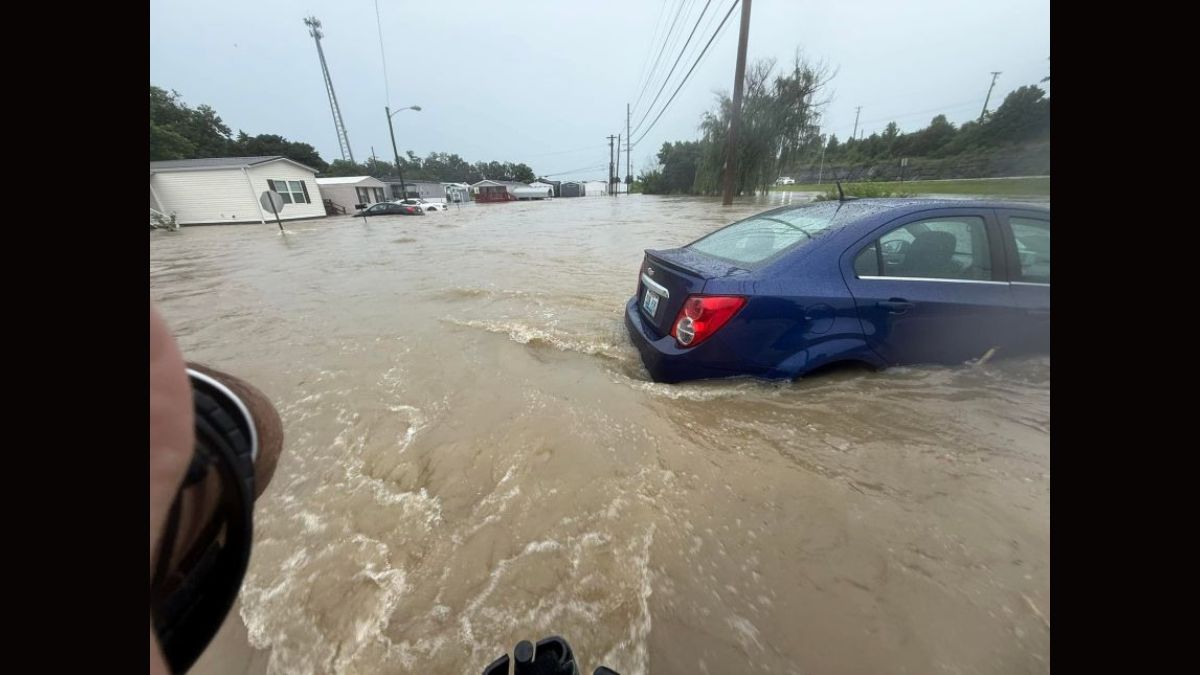
Madison County, KY – Severe storms and relentless rain have turned parts of Kentucky into disaster zones, with floodwaters claiming at least four lives and forcing more than 60 water rescues across the state.
Governor Andy Beshear declared a state of emergency on June 27 after several counties recorded historic rainfall totals in a matter of hours, and by Sunday afternoon, he confirmed that conditions were finally beginning to improve, even as recovery efforts were only just getting underway.
The hardest hit areas included Madison, Mercer, and Jackson counties, where rainfall in some spots reached eight to twelve inches over a 48 hour stretch.
Officials say one person drowned in Jackson County while three others died in Madison County, including a man and woman who were trapped in the basement of a flooded home in Richmond.
Rescue crews were unable to reach the residence in time because it was already submerged when they arrived.
Beshear expressed grief over the losses, saying the flooding had taken the lives of four Kentuckians far too soon.
He noted that this marks the 16th weather-related disaster the state has faced in roughly six and a half years, a sobering reminder of how often Kentucky communities have had to rebuild in recent memory.
Counties and Cities Declare Local Emergencies
As floodwaters spread, thirteen counties and five cities declared their own local states of emergency.
The counties affected span central, southern, and western Kentucky, including Bullitt, Clinton, Cumberland, Garrard, Grayson, Jackson, Jessamine, Madison, Meade, Mercer, Metcalfe, Spencer, and Wayne. The cities of Albany, Brandenburg, Burkesville, McKee, and Muldraugh also issued local emergency declarations.
In Madison County alone, seventeen households are currently sheltering, and roughly 320 homes remain without running water.
At least a dozen roads across the state are impassable, and several bridges, particularly in Jessamine County, were reportedly washed out entirely. In Richmond, a historic church appeared to collapse amid the storm, and city officials say major intersections remain underwater.
In Bullitt County, precautionary evacuations were ordered after a dam experienced a landslide, though emergency officials say there is no indication the structure is at risk of failing.
What Comes Next for Recovery
With the worst of the rain easing, attention is now turning toward recovery and long-term repair. Beshear said his administration plans to request both individual and public assistance from the federal government, aiming to help families rebuild and to repair washed-out roads and bridges across rural parts of the state.
The governor has also activated price gouging protections to prevent businesses from overcharging residents for essential goods and services during the crisis, and he signed an order allowing pharmacies in affected areas to issue emergency prescription refills.
Officials continue to urge residents to avoid unnecessary travel, especially after dark, as saturated ground could still trigger additional flooding in the days ahead.
Anyone needing non-emergency assistance is asked to call the State Warning Point line so that 911 lines stay open for life-threatening situations.