Baton Rouge, Louisiana — A brilliant fireball lit up the predawn sky across south Louisiana early Sunday morning, sending residents from Baton Rouge to St. Francisville reaching for their phones to capture the rare sight.
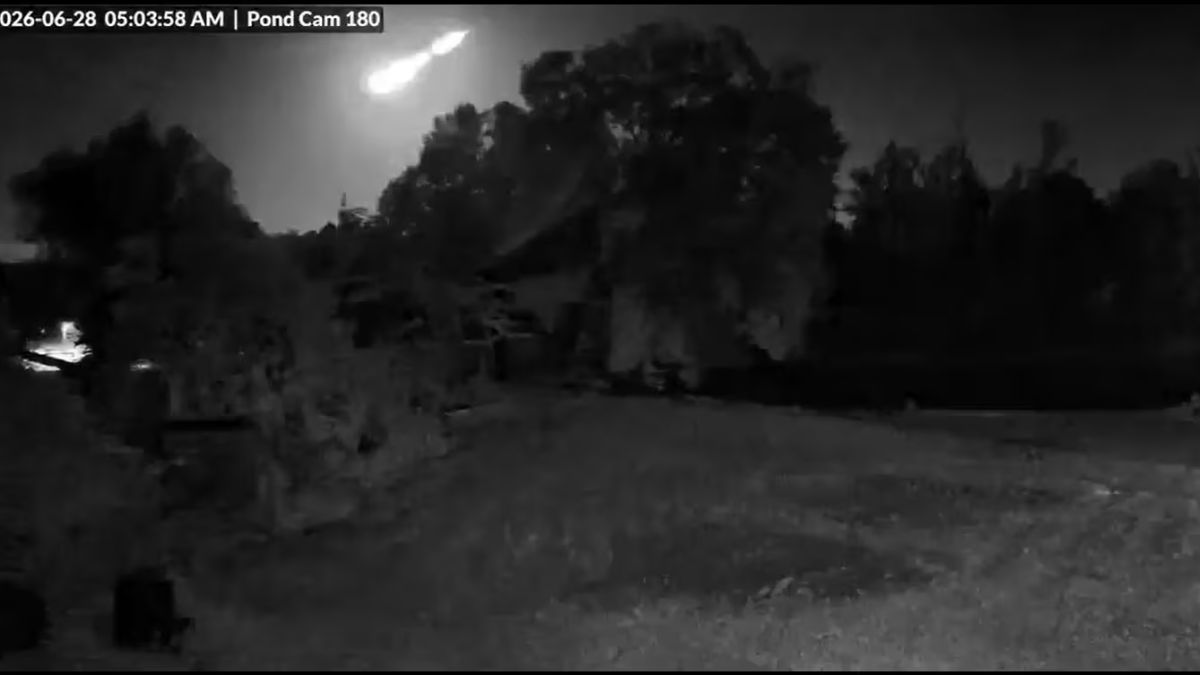
The streak of light appeared shortly after 5 a.m. on June 28, and within minutes, reports were pouring in from witnesses across several southern states.
According to WAFB’s Sky9 camera network, the clearest footage came from a camera mounted atop Our Lady of the Lake Hospital on Essen Lane in Baton Rouge.
Other cameras in the network missed the fireball itself but still picked up the bright flash it cast across the sky as it passed. Most people who saw it said the object appeared low in the eastern or southeastern sky.
Viewers also sent in their own recordings. Alex Jerome shared security camera video from his property in Denham Springs, while Katie Bownds submitted a clip captured by her doorbell camera in St. Francisville.
Both videos line up with the general direction reported by other witnesses, showing the object streaking through the eastern sky before fading out.
What Makes a Fireball Different From a Shooting Star
Most people are familiar with ordinary shooting stars, the quick streaks of light caused by small bits of space debris burning up in the atmosphere. A fireball is a much bigger and brighter version of that same event.
The American Meteor Society classifies a fireball as a meteor that reaches a brightness similar to the planet Venus, which makes it stand out far more than a typical meteor.
These dramatic displays happen when larger chunks of space rock, sometimes ranging from pebble-sized to as wide as a few feet across, slam into Earth’s atmosphere at high speed. As the object pushes through the air, friction builds enormous heat, melting its outer layers and often causing it to break apart.
In some cases, the pressure difference between the front and back of the rock becomes too great, leading to a sudden explosion sometimes referred to as a bolide. Because fireballs burn so brightly, they can sometimes be seen for hundreds of miles, and in rare instances, even during daylight hours.
Sightings Stretched Across Several States
The fireball was not just a Louisiana phenomenon. The American Meteor Society’s reporting page showed sightings logged by people in Mississippi, Alabama, Arkansas, and Texas as well, suggesting the object traveled a long path before burning out.
So far, there is no indication that any piece of it survived the trip through the atmosphere to reach the ground, though experts say that determination often takes time.
Astronomers and meteor experts are expected to review the available footage and observer reports in the coming days to pin down details such as the object’s likely size, speed, and trajectory.
They will also work to confirm whether the event should officially be classified as a fireball or, given how bright and explosive it appeared to some witnesses, a bolide.
For now, residents across the region are simply sharing their excitement online, swapping videos and comparing notes on a sky show that gave an entire region something memorable to talk about on a Sunday morning.